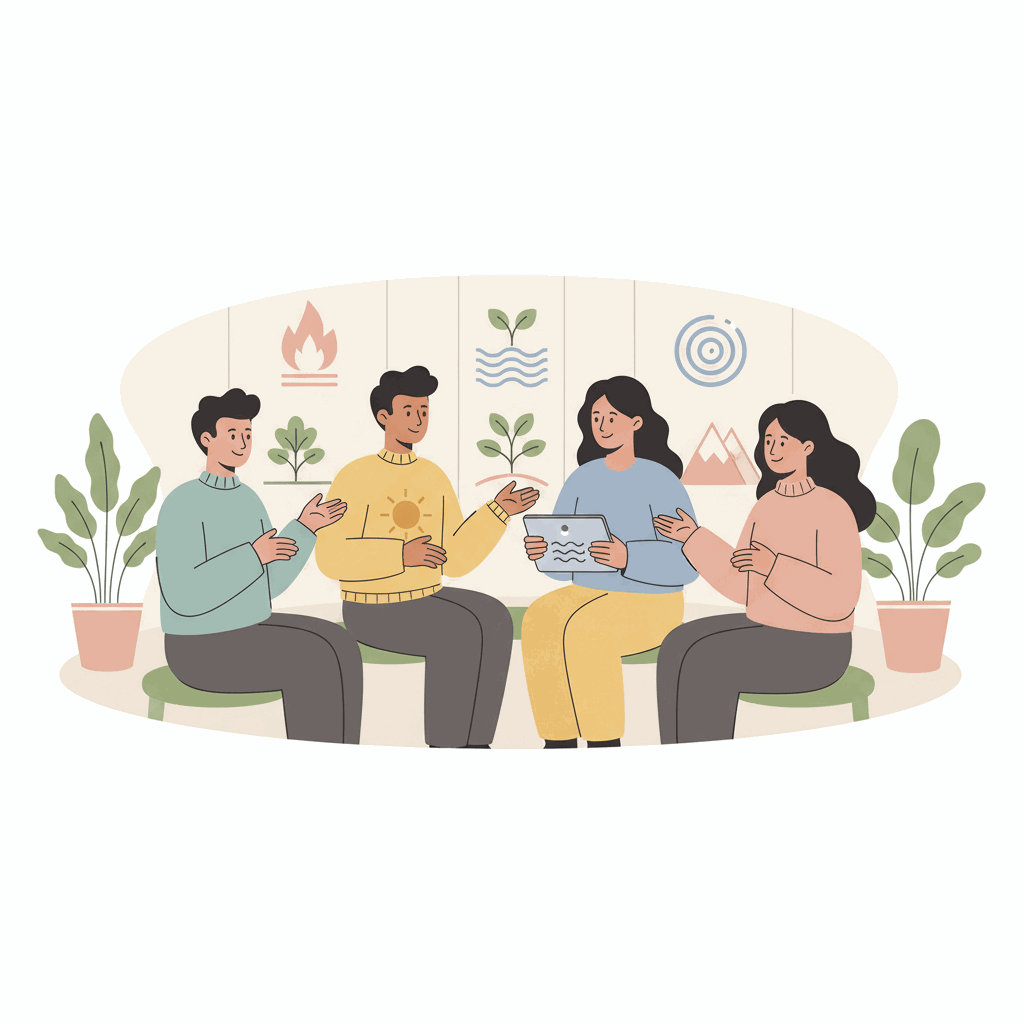
Knowing your energy type (Wood, Fire, Earth, Metal, or Water) is more fun when you can share it. This piece is about how to talk about it with friends, family, or colleagues—without turning it into a label or a debate. I Ching and Bazi are tools for conversation and curiosity, not boxes. The goal is connection and clarity.
TL;DR
- Share your type as "I tend to…" not "I am…."
- Ask others what they relate to; compare notes, don't judge.
- Use it to understand differences and find common ground.
Quick start: Do the Quick Test first, then use the lines below to start a chat.
What this guide is (and is not)
This is a set of conversation starters and habits for talking about energy types in a light, flexible way. It is not a script for convincing anyone or a way to label people. It does not replace professional advice or a full Bazi reading. The goal is to make it easy to share your type and hear others—so you can understand each other better and avoid unnecessary friction. Think of it as a shared language, not a verdict.
Talking about energy in daily life
Energy types show up in how we communicate, decide, and recharge. When you say "I'm more Wood, I like to bounce ideas" or "I'm more Earth, I need a steady routine," you give others a shortcut to understanding you. They can do the same. That shared vocabulary reduces the "why are you so…?" moments and replaces them with "oh, that's your energy—here's mine."
The trick is to keep it soft. "I tend to…" and "I lean toward…" leave room for context and change. "I am Wood" can sound like a fixed identity; "I lean Wood in how I start projects" is a tendency. Same for others: ask what they relate to, and listen. You might discover why your colleague needs a clear agenda (Metal) or why your friend needs space before deciding (Water).
When types clash—e.g. Fire wants to act now, Water wants to think—talking about it can turn conflict into clarity. When they click—e.g. Wood brings ideas, Fire brings drive—naming it can strengthen the team. The aim is always understanding, not right or wrong.
The five directions of balance
Use these five directions when you talk about energy with others: how you speak, how you listen, when types clash, when they click, and how you reset together. Each is a small lever for better conversation.
1) Communication: name your need
Each type communicates differently. Wood likes to explore options; Fire likes to lead the conversation; Earth likes to check everyone's okay; Metal likes clear points; Water likes to listen first. Say one sentence that reflects your need so others don't have to guess.
- Do: Say something like "I need a minute to think" (Water) or "What's our one goal?" (Metal).
- Avoid: Using your type as an excuse ("I'm Fire, I can't slow down").
- Practice: One conversation per day where you name your need in plain words.
2) Listening: ask what they relate to
Instead of guessing someone's type, ask. "Do you know the Five Elements? What do you think you'd get?" or "I read that Fire types like to lead and Earth types like to support—what about you?" Listen for tendencies, not labels.
- Do: Invite them to try the Quick Test or describe themselves in their own words.
- Avoid: Pushing if they're not interested—it's optional fun.
- Practice: One question per chat: "What do you need in this situation?"
3) When types clash: name the difference
Some pairs need more awareness: Fire and Water (action vs. calm), Metal and Wood (structure vs. options). Name the difference without blame: "We're different in how we decide—I like options, you like one clear rule. Can we try one step first?"
- Do: Use the language to explain your need ("I need a few minutes to think").
- Avoid: Using it to put someone in a box ("You're so Metal, you're so rigid").
- Practice: When there's tension, name one difference and one small compromise.
4) When types click: celebrate the fit
Wood and Fire often work well (ideas and drive); Earth and Metal can create stability and order. When you notice a good fit, say it: "We work well because you bring structure and I bring options." That reinforces the team without making it all about types.
- Do: Name one strength the other person brings.
- Avoid: Reducing people to a single element.
- Practice: One appreciation per week that uses the shared language.
5) Personal ritual: a shared check-in
With a partner or team, a short check-in can use the map: "What energy do you need today? What do I need?" Keep it to a minute. It's a way to reset and stay aligned.
- Do: Name one win and one need before you part ways.
- Avoid: Making it heavy or mandatory.
- Practice: A 3-minute conversation ritual when you start a meeting or a meal.
Conversation starters
- "I did a short energy-type quiz—I got Wood. Do you know the Five Elements? What do you think you'd get?"
- "I read that Fire types like to lead and Earth types like to support. I see myself more in the support role—what about you?"
- "We're so different in how we make decisions. I wonder if it's a Wood–Metal thing—I like options, you like one clear rule."
- "What do you need right now—space to think or a clear next step? I can adapt."
The 3-minute conversation ritual
- Name your type (45 seconds): Say or write "I lean toward [Wood/Fire/Earth/Metal/Water]."
- One need (45 seconds): What do you need in conversations? (e.g. time to think, a clear goal, a check-in.)
- One question for the other (45 seconds): What would you like to ask them about their energy or style?
- One next step (45 seconds): One small way you'll use this in the next conversation (e.g. name your need, ask one question).
Element cues (mini guide)
- Wood: "I like to bounce ideas." "What are our options?"
- Fire: "I need a clear win." "Let's decide and go."
- Earth: "Is everyone okay?" "I need a steady routine."
- Metal: "What's the one rule?" "I need clarity."
- Water: "I need a minute to think." "Let me listen first."
Common mistakes
- Using your type or theirs as a fixed label ("You're so…").
- Treating it as science or fate instead of a useful lens.
- Pushing the topic when the other person isn't interested.
Key Takeaways
- Share your type as a tendency, not a fixed identity.
- Ask, listen, compare—no right answer.
- Use the language to understand each other and reduce friction.
Related Guidance
Try it now: Use one conversation starter with someone you know, or do the 3-minute conversation ritual and open Get Today's Calm for a gentle next step.